Your AI writes like a performer. Make it write like a salesman.
Ask an AI to write your ad and you get "Melbourne's trusted experts. Quality service you can rely on." It reads fine. It sells nothing. This guide gives you 7 rules from Claude Hopkins, tested on thousands of coupon-coded ads, and an instruction for each one you can give your AI today.
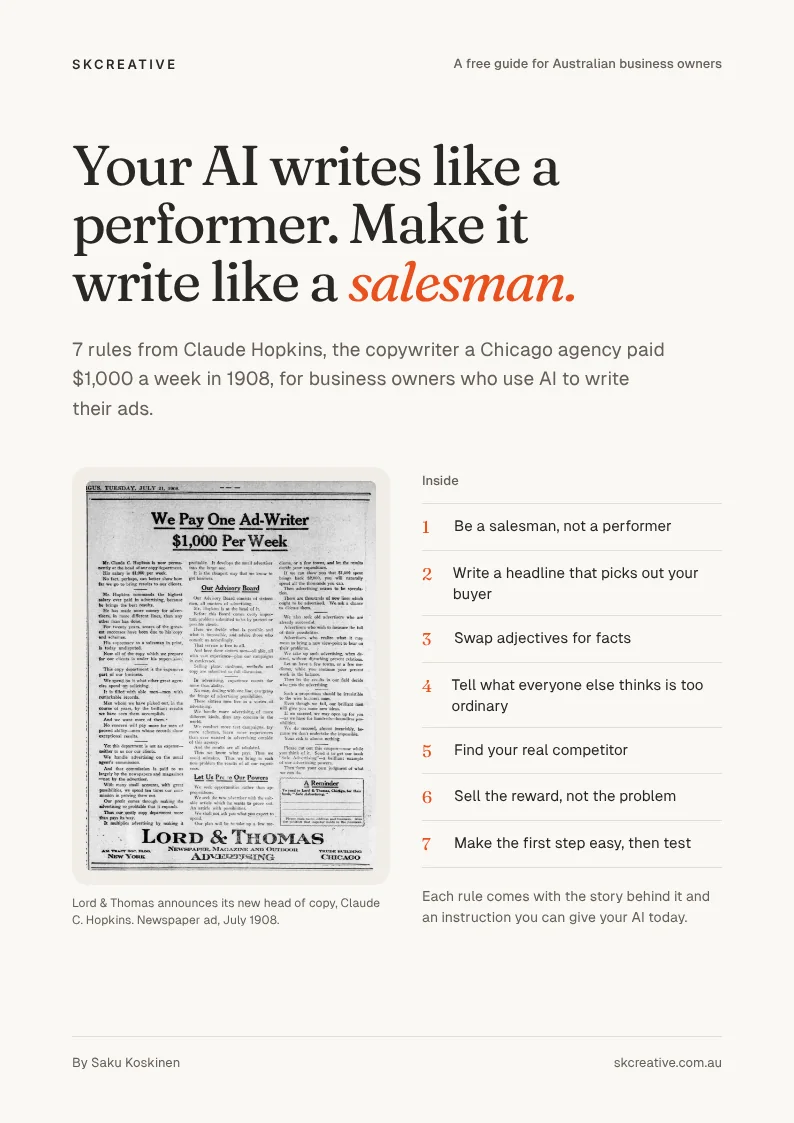
Seven rules, one page each.
- 1Be a salesman, not a performer
- 2Write a headline that picks out your buyer
- 3Swap adjectives for facts
- 4Tell what everyone else thinks is too ordinary
- 5Find your real competitor
- 6Sell the reward, not the problem
- 7Make the first step easy, then test
Every rule comes with the story behind it, a direct Hopkins quote, and an instruction to paste into your AI. Page 9 has an 8-question scorecard to use on your next ad before you spend a dollar on it.
Paid $1,000 a week in 1908
Claude Hopkins wrote for Schlitz, Quaker, Palmolive, Pepsodent and Goodyear. He couldn't measure clicks, so he coded every coupon and kept only what sold. His rules ban exactly what AI does by default: vague claims, superlatives and clever lines.
Saku Koskinen
Melbourne marketing consultant. Since 2019 I've written the copy for 200+ websites and landing pages and run Google Ads for small businesses across Australia.
The Hopkins Copy Kit
The rules from the guide, installed into Claude as two skills, with headline patterns, a review checklist and Australian guardrails.
See the KitQuestions worth asking.
Who is the guide for?
Business owners who use AI tools like ChatGPT or Claude to write ads, emails or website copy, and want it to sell rather than just sound nice.
Who was Claude Hopkins?
An American copywriter whose 1923 book Scientific Advertising set out testable rules for writing ads that sell. The rules still work.
Is it really free?
Yes. Enter your name and email and the guide is yours.
What's the difference between the guide and the Copy Kit?
The guide explains seven rules. The Copy Kit turns them into Claude skills that write and review copy for you.