Creative Marketing Strategies: 10 Simple Ideas That Work in 2026
 Saku Koskinen23 Dec 2021 · Updated 29 Oct 2026· 7 min read
A creative marketing strategy is a simple, memorable way of showing customers why you're the better choice. The best ones are rarely award-winning ideas. They're clear: a before and after, a real customer talking, a smaller brand turning that into a strength. Below are 10 creative marketing strategies, five classics that have worked for decades and five that reflect how people find and choose businesses in 2026.
Simple ideas usually work better. They're easier for your customer to understand, quicker to make and cheaper to produce. Every strategy here can be used by a small business with a phone, a website and a modest budget.
What is a creative marketing strategy?
Your marketing strategy decides who you're talking to, what you want them to do and where you'll reach them. Your creative strategy decides how you say it: the angle, the story, the format and the words. A great creative strategy takes one true thing about your business and makes it easy to notice and hard to forget.
If you only remember one rule, make it this: one audience, one message, one clear next step. Everything below is a way of delivering that message more memorably.
5 classic creative marketing strategies that still work
1. The before and after
Show your customer life without your product, then life with it. This makes the benefit obvious in seconds, which is exactly what you need when people are scrolling.
You can show a before and after with:
- photos or short videos (a renovated kitchen, a cleaned-up garden, a new website)
- numbers (time saved, bills reduced, enquiries increased)
- case studies that walk through the problem, the work and the result
For example, for a local electrical contractor I rebuilt the landing page and ran Google Ads, and the page converted at 18.6% over a five-month period. That one sentence is a before and after: a page that wasn't doing its job, and one that is.
2. The testimonial
Let happy customers say good things about you in their own words. This is still one of the most persuasive things you can do. BrightLocal's 2026 Local Consumer Review Survey of US consumers found 97% read reviews for local businesses, and 85% are more likely to use a business after reading positive ones.
Two common mistakes to avoid:
- Too polished. A scripted, studio-lit testimonial feels rehearsed. A customer filming 30 seconds on their phone often feels more credible.
- Celebrity over substance. Advertising legend David Ogilvy warned that with celebrity testimonials, people remember the celebrity but forget the product, and assume the celebrity has been paid.
Keep them fresh, too. The same survey found 74% of consumers look for reviews written in the last three months. Ask for reviews and video testimonials as a regular habit, not a one-off project.
3. The knowledge strategy
Show how well you understand your customer's problem. This matters most when you sell expertise, such as consulting, coaching, trades or professional services. Your prospects are silently asking three questions:
- Has this person done what they're describing?
- Have they helped other people get this result?
- Can they help me get it?
Your marketing should answer "yes" to all three. Useful formats include short videos answering common questions, articles, webinars, downloadable checklists and podcasts. Teaching builds trust before the first conversation.
4. Negative to positive
This strategy turns a weakness, or a boring category, into a reason to choose you. It works well when you're smaller than your competitors or your industry isn't exciting.
The classic example is Avis. In 1962, Avis was a distant second to Hertz in car rental. Its agency, Doyle Dane Bernbach, turned that into the line "When you're only No. 2, you try harder". Being number two became the reason to book.
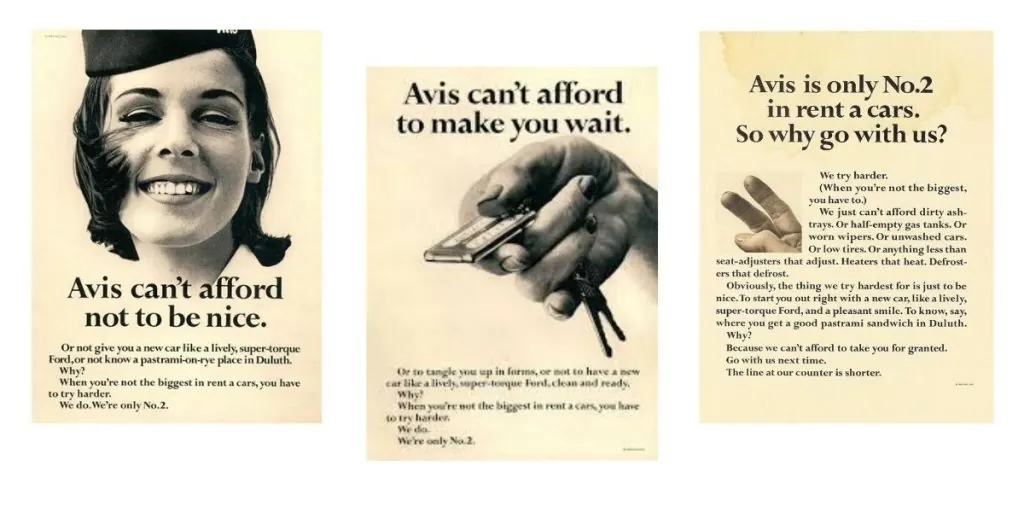
Small business versions: "We're small, so you'll always deal with the owner." "We only do one thing, so we're very good at it." "We're not the cheapest, and here's what you get for the difference."
5. The comparison
If you have a real advantage over your competitors, say so. The key is finding something your main competitor can't say. It could be your:
- price or pricing model
- unique selling point
- location or response time
- technology or process
- people and qualifications
- guarantee
You can be subtle or direct, but stay accurate. In Australia, the ACCC says comparative advertising is allowed, but it can be misleading if the comparison is inaccurate or doesn't compare products fairly, and a business must be able to prove any claim it advertises. For more ways to find your edge, read my guide on how to stand out from your competitors.
5 creative strategies for how people choose in 2026
When I wrote about digital marketing trends in 2021, the big themes were authenticity, featured snippets, sustainability, interactive content and local SEO. Most of those ideas have grown up rather than gone away. Here's how I'd use them now.
6. Let real people carry your message
Content from customers, staff and creators feels like a recommendation, not an ad. Meta has built a whole ad format around this: partnership ads, which run from a creator's account as well as yours. Meta's CFO said partnership ads passed a US$15 billion annual revenue run rate in Q3 2026, as reported by Relevant Audience.
You don't need famous influencers. A regular customer, a local micro-creator or your own team can do this well. See my Facebook ad examples for brands doing it at scale.
7. Answer the question, not just the keyword
In 2021 the goal was to win Google's featured snippet. Today people also ask AI tools for recommendations. BrightLocal's 2026 survey found the share of consumers using ChatGPT and other AI tools for local recommendations jumped from 6% to 45% since its previous survey.
The creative response is the same as the knowledge strategy above, just sharper: write pages that answer real customer questions directly in the first two sentences, use your own numbers and examples, and keep your business details consistent everywhere. Clear, specific answers are easier for both Google and AI tools to understand and quote.
8. Win the local search moment
If you serve a local area, your Google Business Profile (the old Google My Business, renamed in 2021) is often the first thing people see. Treat it as creative real estate: real photos of your team and work, regular posts, answers to common questions and a steady flow of fresh reviews.
Your website matters here too. For an Australian wedding venue and hotel, a website redesign and SEO work delivered a 2x uplift in enquiries. My guide to local business SEO covers the basics.
9. Make it interactive
Interactive content gives people a reason to engage and a result they care about. Ideas that suit small businesses:
- a quote or cost calculator ("What would solar cost for my home?")
- a short quiz that recommends a product or package
- a checklist or self-assessment ("Is your website losing leads?")
- polls and questions in Instagram Stories
The best interactive tools also qualify your leads, because people tell you what they need before they enquire.
10. Be honest about your values
Customers care about how businesses act, including sustainability and inclusion. The creative opportunity is to show, not claim. Show the real range of people you serve in your photos and stories. If you make environmental claims, be specific and able to back them up. The ACCC published a guide to making environmental claims in December 2023 that sets out what it considers misleading and what good practice looks like. "Made with 80% recycled packaging" beats "eco-friendly" every time.
How to turn a creative idea into a campaign
Ideas are cheap. Execution is where most campaigns fall over. Here's the simple process I use:
- Pick one audience. Who exactly is this for, and what problem keeps them up at night?
- Pick one strategy from this list. Match it to your strength. Lots of happy customers? Testimonials. Smaller than your competitors? Negative to positive.
- Write a one-page brief. My guide on how to write a marketing brief walks you through it.
- Make three versions. Different hooks, formats or angles, so you learn something.
- Run it for long enough. Give paid campaigns at least two to four weeks before judging.
- Measure what matters. Enquiries, sales and cost per customer, not just likes.
Frequently asked questions
What is a creative marketing strategy?
It's the plan for how you'll communicate your message: the angle, story and format that make your business memorable. Strategy decides who and what; creative decides how.
What are some creative marketing ideas for small businesses?
Customer video testimonials, before and after content, a short founder story, a cost calculator on your website and an honest comparison with the alternatives are all affordable and effective. Pick the one that best shows your real strength.
What is the difference between creative strategy and campaign strategy?
Campaign strategy covers the goal, audience, channels, budget and timing. Creative strategy covers the message and how it's expressed. You need both, and the creative should follow from the strategy, not the other way around.
Creative marketing strategies don't have to be complicated, but they do need to be chosen and executed with a plan. If you'd like help picking the right one for your business and turning it into campaigns that bring in enquiries, take a look at my digital marketing strategy service, or book a free call.
A clear plan for who to target, what to say and where to spend.
Freelance digital marketing consultant in Melbourne. Since 2019 I've built websites, ads and campaigns for 100+ Australian businesses.